Noverqixa
Slate Library
Slate Library
Couldn't load pickup availability
1. Problem Statement
Larger JavaScript projects can become difficult to maintain when every function depends on several unrelated parts of the code. A small adjustment may affect data processing, interface behaviour, and output formatting at the same time. Learners may also find it challenging to decide where validation, error handling, and repeated logic should be placed. Without consistent testing, an issue may remain hidden until a particular input or sequence of actions appears. A clearer structural method is needed to keep responsibilities separated while allowing each part of the project to work together.
2. Solution
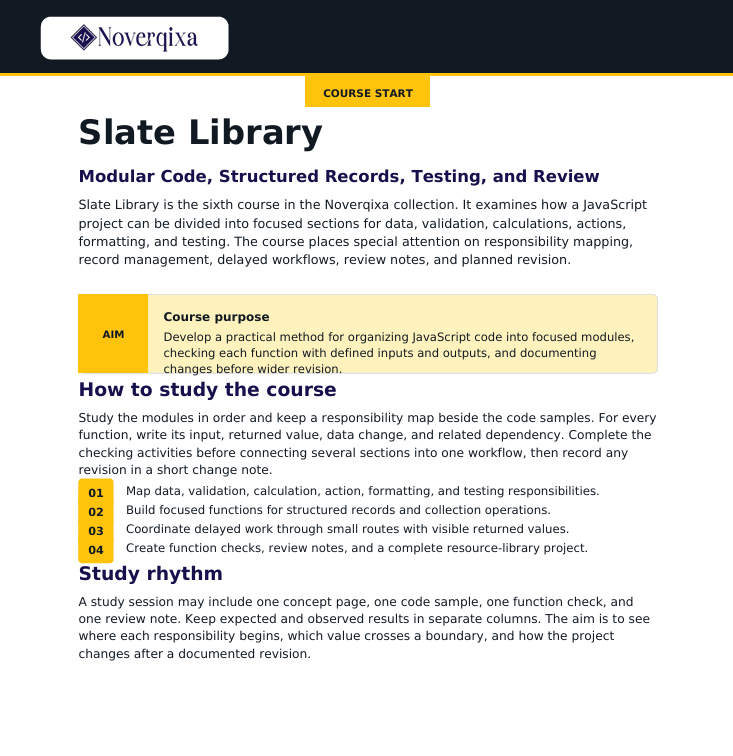
Slate Library introduces a modular approach to JavaScript planning and development. Learners divide project logic into sections with defined roles, such as data storage, validation, calculations, action handling, and output preparation. Each module shows how these sections exchange information through clear inputs and returned values. Practical exercises include testing individual functions before connecting them to a wider workflow. This structure helps learners review, adjust, and extend JavaScript code with greater clarity.
3. What’s Inside
The opening module focuses on responsibility mapping. Learners examine a complete JavaScript task and identify which parts handle data, decisions, calculations, updates, and presentation. They then reorganize the task into smaller sections with focused names and clear boundaries.
The modular-functions section explores how functions can be grouped according to purpose. Learners create utility functions, validation functions, data-processing functions, and output-formatting functions. Exercises show how to reduce hidden dependencies and avoid using shared values unnecessarily.
A detailed data-layer module introduces structured records, identifiers, categories, timestamps, statuses, and related entries. Learners practise creating, retrieving, updating, and removing records through focused functions rather than changing the collection directly from several locations.
The asynchronous-workflow section examines operations that complete at different times. Learners coordinate sequential tasks, handle several operations together, review returned values, and create fallback behaviour when a step cannot be completed as expected.
The testing module introduces input-and-output checks for individual functions. Learners create test cases for ordinary values, empty entries, boundary values, missing properties, and incorrect formats. Activities encourage comparing expected results with actual results before integrating each function into the wider structure.
A code-review section covers naming, function length, repeated logic, data mutation, nested conditions, and unclear dependencies. Learners evaluate sample structures and document suggested revisions before rewriting them.
The final assignment involves creating a JavaScript resource library. Learners define structured entries, validate new records, filter and group collections, update selected information, coordinate delayed operations, format summaries, and test each major function independently.
4. Who Is This For?
Slate Library is intended for learners who are comfortable with JavaScript functions, objects, collections, conditions, and asynchronous operations. It suits those who want to work with broader project structures and clearer separation of responsibilities. The course is also relevant for learners interested in testing habits, code review, and modular planning.
5. What You’ll Learn
- Map responsibilities within a JavaScript project
- Divide connected logic into focused sections
- Group functions according to purpose
- Reduce unnecessary shared values
- Design structured data records
- Create focused record-management functions
- Coordinate sequential asynchronous operations
- Handle several delayed tasks
- Write input-and-output test cases
- Check boundary values and missing information
- Review naming and function structure
- Identify repeated or tightly connected logic
- Document code-review observations
- Build and test a JavaScript resource library
6. 30-Day Refund Terms
Customers may submit a refund request within 30 calendar days of purchasing Slate Library. Requests are reviewed according to the refund terms published on the Noverqixa website and the information connected with the order. The published terms describe the submission procedure, review criteria, and relevant timeframes.
Self-paced learning overview
- 📘 Course materials provided after purchase
- 🗂️ Long-term course availability
- 🔒 Protected checkout process
- 🗓️ Materials updated in 2026
What format do the Noverqixa courses follow?
What format do the Noverqixa courses follow?
Each course is arranged into themed modules with explanations, code examples, review notes, and practical assignments. The topics follow a gradual order so learners can study one concept at a time and connect it with later material.
Do I need previous JavaScript knowledge?
Do I need previous JavaScript knowledge?
The collection includes courses for different learning stages. Earlier courses introduce foundational ideas, while later courses examine broader structures, code organization, data handling, and larger practical assignments.
Can I study at my own pace?
Can I study at my own pace?
Yes. The materials can be reviewed according to your personal schedule. Learners may repeat explanations, revisit code examples, complete assignments gradually, and keep personal notes while moving through each module.
Share