Noverqixa
Luma Guide
Luma Guide
Couldn't load pickup availability
1. Problem Statement
Learners may understand foundational JavaScript syntax but still find it difficult to organize code across several connected tasks. As code grows, repeated statements, unclear variable names, and tightly connected logic can make a project difficult to review. Objects and collections may also feel confusing when nested data or several update steps appear in one example. Without a clear planning method, learners may begin writing code before identifying the required values, actions, and expected output. This can lead to structures that work in one case but become difficult to adjust when requirements change.
2. Solution
Luma Guide introduces a structured approach to planning and writing JavaScript code. Each module demonstrates how a larger task can be divided into smaller sections with clear responsibilities. Learners examine how information enters a function, how it is processed, and how the result is used elsewhere. Guided exercises encourage readable naming, careful data organization, and regular review of program flow. The course helps learners develop practical habits for creating code that can be studied, adjusted, and extended over time.
3. What’s Inside
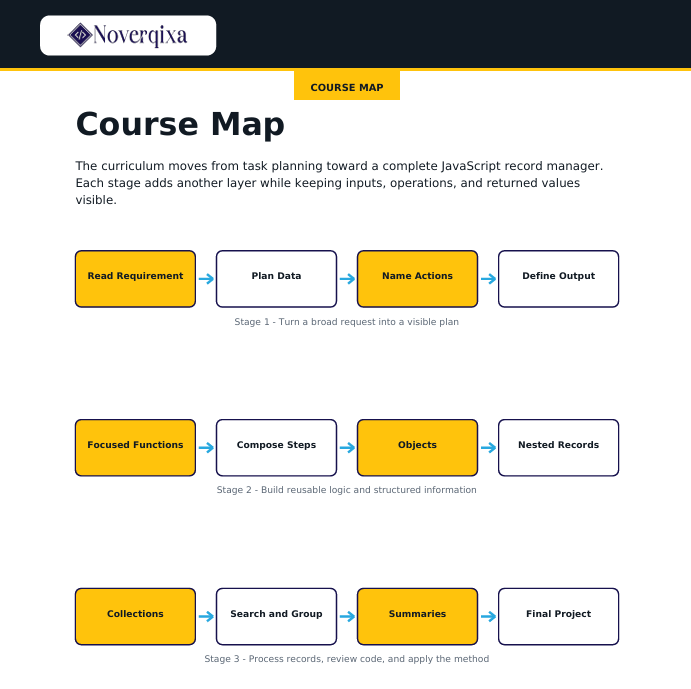
The course opens with a review of functions and reusable logic. Learners compare functions that perform one focused action with functions that try to handle several unrelated tasks. Exercises cover parameters, returned values, default values, internal variables, and function composition.
A detailed objects module introduces key-and-value structures used to describe related information. Learners create objects, retrieve entries, update values, add new properties, and combine objects with conditional logic. Examples include records, settings, task entries, and structured content data.
The collections module examines how multiple objects can be stored and processed together. Learners search for matching entries, calculate totals, group information, create filtered collections, and produce updated versions without changing the original source.
Another section focuses on repetition and data processing. Learners compare several iteration patterns and study when each structure is suitable. Practice tasks include checking values, formatting entries, building summaries, and stopping an operation when a defined condition is met.
The code organization module covers naming, indentation, focused functions, repeated logic, comments, and separation of responsibilities. Learners review crowded examples and rewrite them into smaller, clearer sections.
Debugging activities introduce data-tracing tables, output checks, boundary cases, and step-by-step review. Learners identify incorrect conditions, missing return statements, unintended value changes, and collection-processing errors.
The final assignment involves creating a structured JavaScript record manager. Learners plan the data model, write focused functions, validate entries, update stored information, produce summaries, and review the complete structure using a detailed checklist.
4. Who Is This For?
Luma Guide is intended for learners who understand variables, conditions, functions, and introductory collections. It suits those who want to move from isolated exercises toward connected JavaScript tasks. The course is also useful for learners seeking further practice with objects, data processing, code review, and reusable structures.
5. What You’ll Learn
- Plan JavaScript tasks before writing code
- Divide larger tasks into focused functions
- Work with parameters, returned values, and default values
- Create and update objects
- Store related objects inside collections
- Search, filter, group, and summarize data
- Compare different iteration structures
- Trace values through several processing stages
- Reduce repeated statements
- Improve naming and code organization
- Identify unintended value changes
- Review boundary cases and unusual inputs
- Build a compact record-management assignment
6. 30-Day Refund Terms
Customers may submit a refund request within 30 calendar days of purchasing Luma Guide. Requests are considered according to the refund terms published on the Noverqixa website and the information linked to the order. The published terms describe the request procedure, review process, and applicable conditions.
Self-paced learning overview
- 📘 Course materials provided after purchase
- 🗂️ Long-term course availability
- 🔒 Protected checkout process
- 🗓️ Materials updated in 2026
What format do the Noverqixa courses follow?
What format do the Noverqixa courses follow?
Each course is arranged into themed modules with explanations, code examples, review notes, and practical assignments. The topics follow a gradual order so learners can study one concept at a time and connect it with later material.
Do I need previous JavaScript knowledge?
Do I need previous JavaScript knowledge?
The collection includes courses for different learning stages. Earlier courses introduce foundational ideas, while later courses examine broader structures, code organization, data handling, and larger practical assignments.
Can I study at my own pace?
Can I study at my own pace?
Yes. The materials can be reviewed according to your personal schedule. Learners may repeat explanations, revisit code examples, complete assignments gradually, and keep personal notes while moving through each module.
Share