Noverqixa
Echo Framework
Echo Framework
Couldn't load pickup availability
1. Problem Statement
As JavaScript projects expand, closely connected modules can create unclear dependencies and unpredictable behaviour. A change inside one section may unintentionally affect data, interface logic, or calculations elsewhere in the structure. Learners may also struggle to decide how separate modules should exchange information without relying on shared variables. Asynchronous actions can add further complexity when several operations finish in an unexpected order. Without documented boundaries and testing methods, reviewing and extending the code can become difficult.
2. Solution
Echo Framework introduces a structured approach to designing JavaScript systems with clearly defined responsibilities. Learners examine how modules can communicate through parameters, returned values, events, and shared state rules. Each section demonstrates how to reduce hidden connections and keep data changes traceable. Practical activities combine architectural diagrams, implementation tasks, testing routines, and code reviews. This approach helps learners develop organized structures that can be studied and adjusted as new requirements appear.
3. What’s Inside
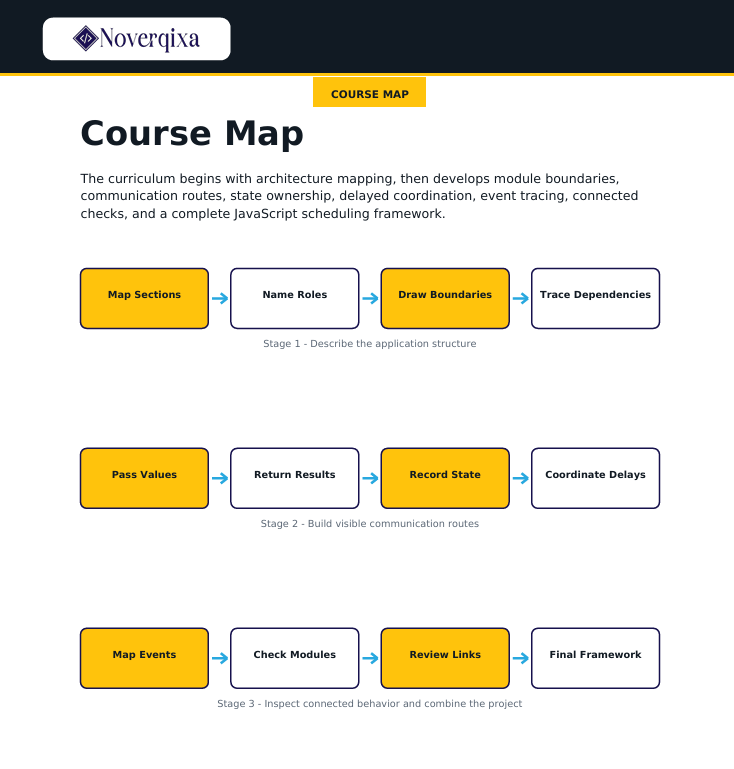
The opening section introduces application architecture mapping. Learners divide a larger task into data, logic, state, interaction, and output areas. Diagrams show how information enters the system, moves between modules, and produces an updated result.
The module-communication section examines several methods for exchanging data. Learners use function parameters, returned objects, callback patterns, and event-based communication. Exercises compare tightly connected modules with structures that use clearer boundaries.
A detailed state-management section explores centralized and section-based state. Learners define state shapes, create controlled update functions, record previous values, and prevent unrelated sections from changing information directly.
The asynchronous-coordination section covers sequential operations, parallel tasks, dependent actions, cancellation conditions, and fallback paths. Learners practise combining several delayed operations while keeping loading, completed, empty, and error states clearly represented.
The event-flow module examines how user actions move through an application. Learners map an action from its starting point through validation, data processing, state revision, and output preparation. Practical tasks include avoiding repeated event handling and managing several related actions.
A testing section introduces isolated module checks, integration checks, and scenario-based review. Learners create test data, define expected outputs, inspect state changes, and examine unusual sequences of actions.
The maintenance section focuses on naming conventions, module boundaries, documentation notes, repeated patterns, and dependency review. Learners inspect an existing structure and prepare a revision plan before changing the code.
The final assignment involves creating a JavaScript scheduling framework. Learners define structured records, coordinate state changes, validate entries, manage asynchronous updates, connect event flows, and test interactions between individual modules.
4. Who Is This For?
Echo Framework is intended for learners familiar with JavaScript modules, objects, collections, functions, asynchronous operations, and application state. It suits those who want to study broader architectural decisions and communication between separate code sections. The course is also relevant for learners preparing to organize larger assignments with several connected workflows.
5. What You’ll Learn
- Map JavaScript application architecture
- Define clear responsibilities for separate modules
- Exchange information through parameters and returned values
- Use event-based communication patterns
- Design structured application state
- Control how and where state changes occur
- Coordinate sequential and parallel operations
- Represent loading, empty, completed, and error states
- Trace user actions through several processing stages
- Reduce hidden dependencies
- Create isolated module checks
- Review interactions between connected sections
- Document architectural decisions
- Build a structured scheduling framework
6. 30-Day Refund Terms
Customers may submit a refund request within 30 calendar days of purchasing Echo Framework. Requests are reviewed according to the refund terms published on the Noverqixa website and the order information supplied during checkout. The published terms explain the submission steps, review conditions, and applicable timeframes.
Self-paced learning overview
- 📘 Course materials provided after purchase
- 🗂️ Long-term course availability
- 🔒 Protected checkout process
- 🗓️ Materials updated in 2026
What format do the Noverqixa courses follow?
What format do the Noverqixa courses follow?
Each course is arranged into themed modules with explanations, code examples, review notes, and practical assignments. The topics follow a gradual order so learners can study one concept at a time and connect it with later material.
Do I need previous JavaScript knowledge?
Do I need previous JavaScript knowledge?
The collection includes courses for different learning stages. Earlier courses introduce foundational ideas, while later courses examine broader structures, code organization, data handling, and larger practical assignments.
Can I study at my own pace?
Can I study at my own pace?
Yes. The materials can be reviewed according to your personal schedule. Learners may repeat explanations, revisit code examples, complete assignments gradually, and keep personal notes while moving through each module.
Share