Noverqixa
Cipher Archive
Cipher Archive
Couldn't load pickup availability
1. Problem Statement
Learners often understand individual JavaScript commands but struggle when several concepts appear in the same task. Variables, functions, conditions, and collections may seem clear separately, yet their relationships can become difficult to follow inside a larger code structure. Without regular code-reading practice, it can also be challenging to understand why a program produces a particular result. Repeated syntax exercises alone may not develop the ability to plan, organize, and review a complete solution. Learners therefore need materials that connect foundational concepts through detailed examples and progressively layered assignments.
2. Solution
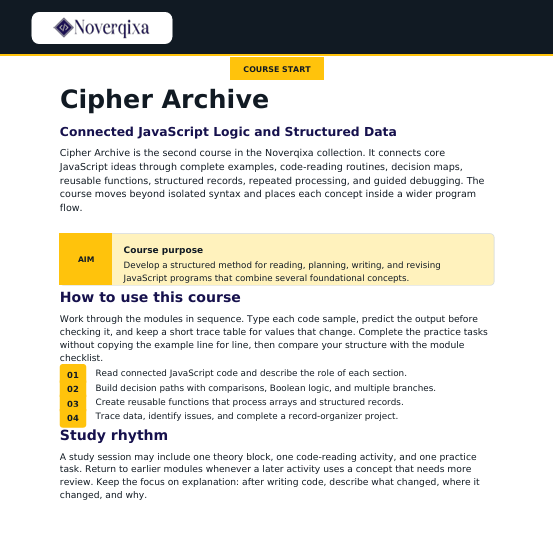
Cipher Archive presents JavaScript as a connected system rather than a collection of isolated commands. Each module begins with a focused concept and then demonstrates how it relates to previously studied material. Learners examine complete examples, trace data through each stage, and identify the purpose of individual statements. Guided assignments encourage learners to plan a solution before writing code and review the result after completion. This structure supports the development of thoughtful coding habits and a clearer understanding of program flow.
3. What’s Inside
The opening module reviews JavaScript values, variables, operators, and expressions. Learners study naming choices, value updates, readable statement structure, and the difference between assignment and comparison.
The decision-making module examines conditional structures in greater detail. It covers multiple branches, nested conditions, combined comparisons, and the use of true-or-false logic when evaluating several requirements.
A full section is dedicated to functions. Learners explore parameters, returned results, internal variables, repeated calls, and the process of dividing one task into smaller reusable parts. Examples show how functions can receive information, process it, and provide a new value for another part of the program.
The collections section introduces ordered groups of values and key-based data structures. Learners practise reading entries, updating information, adding new data, removing unnecessary entries, and combining collections with functions and conditions.
Another module focuses on repetition. Learners study repeated actions, stopping conditions, counters, and the careful handling of collection entries. Comparison exercises demonstrate several ways to process the same group of values.
Cipher Archive also includes debugging activities. Learners review code containing missing symbols, incorrect comparisons, misplaced statements, and unexpected value changes. Each activity encourages careful observation rather than random correction.
The final assignment brings the main topics together in a compact data-handling project. Learners plan the required values, create reusable functions, apply decision logic, process grouped information, and review the output through a structured checklist.
4. Who Is This For?
Cipher Archive is intended for learners who already recognize introductory JavaScript syntax and want to develop stronger connections between core concepts. It is suitable for those who can follow short examples but would like more practice with complete program structures. The course also supports learners returning to JavaScript after a break and seeking an organized review.
5. What You’ll Learn
- Organize JavaScript statements into readable structures
- Compare and update different value types
- Build multi-branch conditional logic
- Combine several comparisons within one decision
- Divide larger tasks into smaller functions
- Use parameters and returned values thoughtfully
- Create and modify grouped data
- Process collections through repeated actions
- Trace how data moves through a program
- Identify syntax and logic issues
- Review code using a structured checklist
- Plan a compact JavaScript task before writing it
- Connect variables, functions, conditions, and collections
6. 30-Day Refund Policy
Customers who purchase Cipher Archive may submit a refund request within 30 calendar days of the original purchase date. Requests are reviewed according to the store’s published refund terms and the details connected with the order. The policy explains the submission process, review conditions, and relevant timeframes.
Self-paced learning overview
- 📘 Course materials provided after purchase
- 🗂️ Long-term course availability
- 🔒 Protected checkout process
- 🗓️ Materials updated in 2026
What format do the Noverqixa courses follow?
What format do the Noverqixa courses follow?
Each course is arranged into themed modules with explanations, code examples, review notes, and practical assignments. The topics follow a gradual order so learners can study one concept at a time and connect it with later material.
Do I need previous JavaScript knowledge?
Do I need previous JavaScript knowledge?
The collection includes courses for different learning stages. Earlier courses introduce foundational ideas, while later courses examine broader structures, code organization, data handling, and larger practical assignments.
Can I study at my own pace?
Can I study at my own pace?
Yes. The materials can be reviewed according to your personal schedule. Learners may repeat explanations, revisit code examples, complete assignments gradually, and keep personal notes while moving through each module.
Share